Google Creates a Secret Internet Clone to Test Its AI Agents
—
# A Virtual Universe to Train Chrome’s Robots
As the integration of Gemini models in the Chrome browser pushes technological boundaries, Google is adopting a stance of absolute caution. AI agents capable of navigating independently, clicking links, or accessing banking accounts require rigorous training. However, exposing them directly to the public Web puts critical infrastructure at major risk.
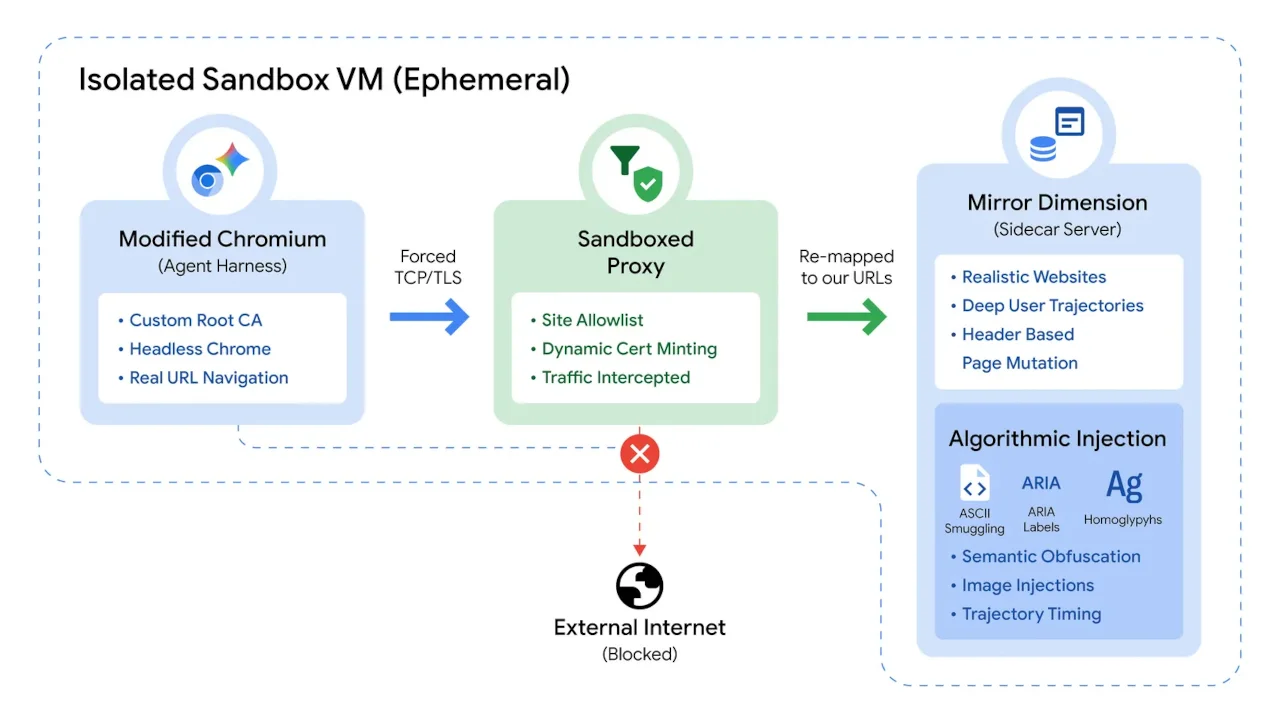
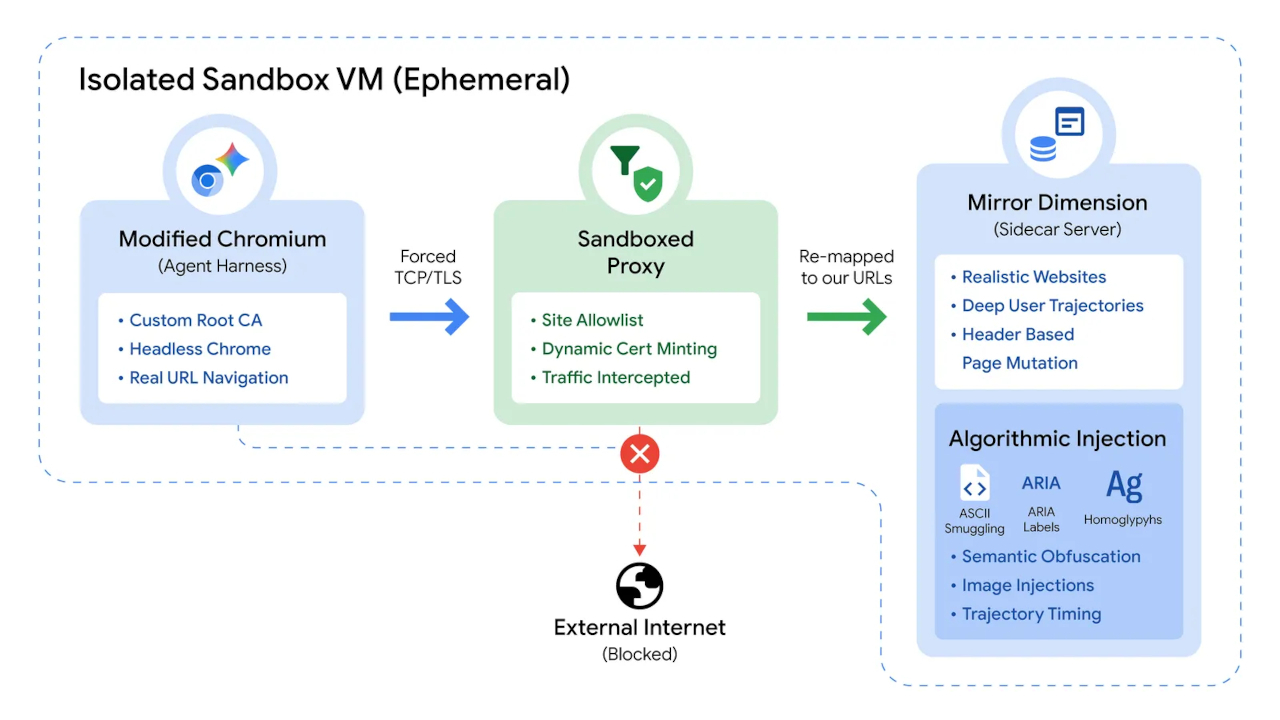
Faced with this dilemma, the tech giant has designed an isolated environment dubbed the “mirror dimension.” It is a faithful and secure copy of the Internet, specifically dedicated to testing autonomous browsers without ever compromising the real network’s security.
How Does This Web Replica Work?
This air-tight infrastructure does more than just copy static pages. It reproduces a functional, living version of the Internet, including complex social networks, dynamic online stores, and even simulated banking interfaces.
The goal is clear: provide algorithms with an authentic, rich, and varied browsing experience while eliminating any risk of external compromise. To populate this virtual universe, Google deploys swarms of specialized AI agents that work in synergy:
- One group defines the technical specifications for sites to be created.
- A second team writes the corresponding HTML and JavaScript code.
- Other agents scrutinize the final rendering to verify accessibility and detect potential errors.
Furthermore, the Chrome browser is configured internally with fake security certificates. This trick allows all traffic within the laboratory to be intercepted without the tested AI agent suspecting any manipulation.
Simulating Attacks to Strengthen Defense
The open Web is teeming with invisible threats, notably the injection of malicious “prompts.” This hacking technique involves hiding dangerous commands in the source code, images, or metadata of a seemingly legitimate site.
If an AI assistant is not robust enough, it could execute these silent orders without the human user being aware. By fully controlling its virtual environment, Google programmatically integrates particularly vicious attack scenarios.
Over a thousand variations of intrusions are subjected to this Internet clone daily. This method significantly accelerates cyber-defense validation cycles, allowing researchers to react faster before a vulnerability is exploited on the real Web.
The Future: Democratizing and Complicating
This Internet clone project solves a critical bottleneck in the production of secure tools. It multiplies the efficiency of security researchers by thirty by delegating a significant portion of the time-consuming work to artificial intelligence.
In the long term, Google plans to open this infrastructure to all its research departments. However, as AI models become more complex, the “mirror dimension” will also need to evolve to maintain an equivalent level of realism and danger.
The balance between rapid innovation and robust security thus becomes the new standard for tomorrow’s autonomous browsers.
—