Review – 1666: Amsterdam
Make yourself comfortable along the canals and keep an eye on the rooftops. After years of limbo, legal battles with Ubisoft, and a long development process at Panache Digital Games, the ill-fated project by Patrice Désilets (the creator ofAssassin’s Creed and Prince of Persia: The Sands of Time) is finally seeing the light of day. Launched in Early Access on August 25, 2026, for PC, 1666: Amsterdam attempts to reinvent historical fiction by infusing it with a healthy dose of the occult and witchcraft.
After scouring the streets, tapping on windows, and questioning suspects for about fifteen hours, here’s our report!
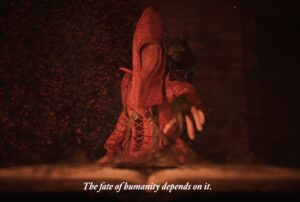
Three eras, a curse, and a cat: The Story
The plot weaves an ambitious tapestry across three distinct time periods connected by family ties and occult forces:
-
The Present: We follow Clio, a college student discovering mystical abilities as she tries to solve the mystery of her father’s disappearance.
-
December 31, 1999: Aaron, Clio’s father, finds himself caught up in strange events at a luxury hotel in Amsterdam (a very bizarre sequence, bordering on B-movie territory, where he runs around in his underwear while the “Free Bird” solo plays).
-
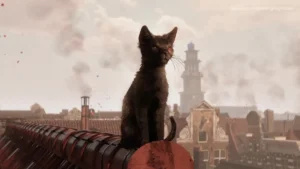
The year 1666: The heart of the game. Aaron finds himself transported into the body of a black cat and becomes Noa Brooklyn’s familiar.
Noa is a Collector belonging to the Zaindari congregation. Her mission? To track down and eliminate the Originals—wizards who sealed a pact with the Devil in 1333 and whose time is now running out. The writing builds a genuine sense of mystery and tension, though the title can at times be unnecessarily verbose, with an overabundance of inner monologues and audio descriptions that slow down the pace.
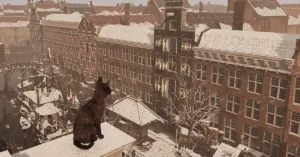
A gripping recreation: Far from the generic open world
The game’s greatest achievement lies in its city. Rather than building a massive map covered with checkboxes, Panache made the wise choice to focus on a dense, meticulously detailed neighborhood.
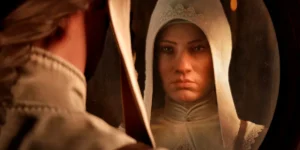
Misty canals, leaning facades from the Golden Age, dangerous alleyways: the historical immersion is total. The art direction works wonders after dark, especially during rituals and occult gatherings (Esbats), when the atmosphere takes a sinister turn without detracting from the city’s architecture. The broom-flying sequences offer stunning panoramic views of the rooftops.
On the audio front, the work is remarkable: period instruments for 1666, electronic touches for 1999, a melancholic piano in the present, and meticulous urban acoustics where every footstep resonates accurately depending on the surface.
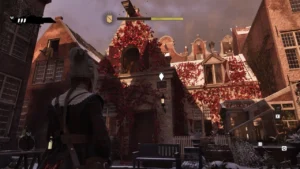
Field investigation and a Stray-style feline duo
To track down an Original, there’s no magic GPS: you really have to investigate. Beneath her civilian guise as an ordinary city dweller, Noa must observe her surroundings, eavesdrop on passersby’s conversations, find posters, and locate target buildings.
This is where the asymmetrical gameplay really comes into its own, thanks to Aaron the cat:
-
Vertical Infiltration: Aaron can squeeze through narrow skylights, climb down gutters, and scale roof trusses to unlock doors from the inside or steal keys that are out of Noa’s reach.
-
Playful possession: The cat can pounce on certain NPCs’ faces to scratch their features and briefly take control of them in order to open guarded doors.
The concept cleverly reinvents how players interact with the environment, even though controlling the cat still lacks precision whenever stairs or complex ledges come into play.
Where it falls short: Clunky combat and clunky stealth mechanics
As soon as subtlety gives way to action, the Early Access version reveals its most glaring limitations. Once the Seal of the Original has been stolen, Noa dons her red witch’s attire to harness the energies of Lux and Nux, glide across water, and cast spells.
Unfortunately, the formula falls apart when you’re holding the controller:
-
Lackluster combat: Stick-based battles boil down to a simplistic combo and a dodging mechanic repeated in a loop. The impact feels lackluster, and targeting becomes chaotic as soon as the camera goes haywire in confined spaces.
-
AI in disarray: The artificial intelligence of guards and civilians is completely unpredictable. Sometimes soldiers ignore you as you walk right past them, while other times they chase you through walls with absurd persistence. As for passersby, they sometimes continue their stroll undisturbed in the midst of magical carnage.
-
Punitive and Repetitive Structure: Failing against a boss or getting captured by the militia forces you to take tedious detours (a trip to prison or respawning in the modern era) that unnecessarily disrupt the flow of progression.
Early Access Status
-
Current content: About 10 to 15 hours of gameplay covering the start of the campaign (the first two monthly hunts) within the first sector of the city.
-
Technical: Regular stuttering, clipping, and very stiff facial animations compared to the beauty of the environments.
-
Localization: Several lines of subtitles remain untranslated and still appear in English.
-
Roadmap: Approximately one year of Early Access planned, with major updates intended to refine the mechanics and expand the city.
A diamond in the rough that needs time to polish
1666: Amsterdam has what so many formulaic productions struggle to find: a soul and a striking visual identity. The historical recreation, co-op exploration with the cat, and the atmosphere of witchcraft lay a solid foundation for an unconventional spiritual successor toAssassin’s Creed. Nevertheless, the game was released far too soon: rudimentary combat, imprecise stealth mechanics, and shoddy technical polish serve as constant reminders that this is a work in progress. It’s a promising curiosity that the curious will keep a close eye on, but one that’s best left to mature over the course of future patches.