Review – Final Fantasy Resonance
Square Enix is making a historic return to its roots. As the saga prepares to celebrate its 40th anniversary and the major numbered entries have moved away from menu-based gameplay in favor of real-time combat, Final Fantasy Resonance is set to launch on October 22, 2026, on PC, PS5, Xbox Series, and Switch 2. Entrusted to the Lancarse studio under the leadership of Team Asano, the project pulls off a true necromantic feat: resurrecting the storyline from Season 1 of the mobile game Final Fantasy: Brave Exvius (which shut down after ten years) by completely stripping away its gacha model to create a premium turn-based JRPG in HD-2D. After spending dozens of hours exploring the world of Lapis and its dungeons on PC, here’s our review!
Shattered crystals and shadowy armor
The story begins in the kingdom of Grandshelt. The elemental crystals that maintain the world’s harmony are being systematically destroyed by an order of six warriors masked beneath heavy black armor. Rain, commander of an airship squadron, and his childhood friend Lasswell are tasked with stopping the slaughter. They soon cross paths with Fina, a young girl with amnesia who emerged from the rubble.
On paper, the plot checks all the boxes for a classic SNES-era JRPG: a coming-of-age quest, brooding knights, and a string of family revelations (everyone seems to be someone’s hidden brother or father). Yet, it all comes together:
-
A likable cast: The chemistry between Rain, Lasswell, and their companions works wonderfully thanks to well-paced dialogue that never drags and is sprinkled with good-natured humor.
-
Careful localization: Unlike some recent mobile games, this title features text fully translated into French, with the option to choose Japanese or English voice acting.
-
Story-driven side quests: While their structure often resembles a delivery mission (FedEx-style), their narratives explore the protagonists’ pasts and provide crucial materials for leveling up your skills.
HD-2D at its best: The end of the diorama syndrome
Ever since *Octopath Traveler*, the HD-2D visual style has suffered from a camera that was often too static, resembling a miniature diorama. *Resonance* finally breaks free from this constraint:
-
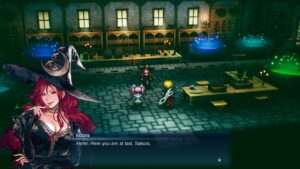
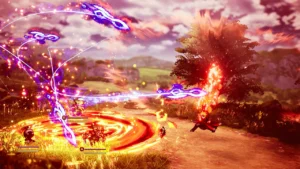
A Lively and Dynamic Camera: In cities and dungeons, the camera swivels around buildings, dives under arches, and follows the action with fluid tracking shots.
-
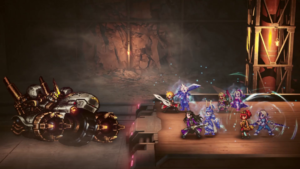
Spectacular Combat: Battles break free from the rigid turn-based format. The staging cuts to the action in the style of modern anime: intense close-ups of impacts, bursts of magical particles, and meticulously crafted pixel art animations.
-
A blend of genres: The game dares to combine 2D sprites, carefully lit 3D environments, and CGI cutscenes to showcase ultimate attacks. The only downside is that some of the finish move videos appear to be taken directly from the mobile version without high-definition processing.
The musical score, orchestrated by Noriyasu Agematsu and his studio Elements Garden (revisiting tracks from *Brave Exvius* and introducing new themes), is a pure symphonic marvel that lends a heroic flair to every battle.
Turn-based combat, Shock Gauge, and Visions system
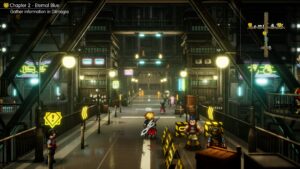
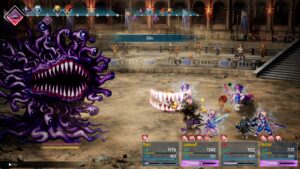
At the heart of the gameplay, the Active Time Battle (ATB) system has been replaced by a purely tactical turn-based system, clearly displaying the order of actions for allies and monsters.
-
The Break System: By targeting the opponent’s elemental or physical weaknesses, you deplete their Stance Gauge. Once stunned, the enemy skips their turn, and the character who delivered the finishing blow gains an immediate bonus action.
-
Resonance Attack: When all monsters on the field are stunned during the same turn, you unleash a devastating combined attack involving your spectral allies.
-
The 26 Visions: This is the major legacy of Brave Exvius, completely rebalanced. No more paid random draws: you collect the spirits of legendary heroes (Cloud, Lightning, Squall, Tidus, Clive…) in dedicated shrines scattered across the map. Equipping a Vision to a hero grants them new roles (Attacker, Defender, Healer, Saboteur), expands their elemental repertoire, and allows them to learn passive skills that remain even after the Vision has been mastered.
-
Free Summons: Iconic Chimeras join battles directly for three turns to unleash their power before finishing with their ultimate attack.
What’s a Bit of a Letdown: The menu design quickly reveals its limitations when faced with the sheer number of abilities. The inability to save equipment profiles or preset builds quickly becomes tedious when you have to reassign skills and Visions for six characters between boss fights. Furthermore, the base difficulty remains fairly lenient: the game doesn’t force players to fully exploit the richness of its synergies until the final chapters and optional boss battles. To experience real tactical tension from the start, jumping straight into Hard mode is highly recommended.
Exploration: The Charm of the World Map
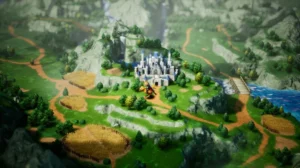
Resonance brings back a true, old-school world map that you can explore on foot, on the back of a chocobo, and then at the controls of the legendary airship unlocked three-quarters of the way through the adventure.
While the atmosphere and the newfound freedom appeal to nostalgia, the map’s level design remains relatively linear: major routes connected by side paths leading to treasure chests or caves. The major dungeons, meanwhile, remain fairly short and compartmentalized, reflecting the game’s original episodic structure.
In terms of playtime, expect to spend between 30 and 35 hours to complete the main story in a straight line. For completionists aiming for 100% (hunting down the 99 tablet fragments, unlocking all Visions, arena challenges, and facing off against the formidable optional boss Sephiroth), the total playtime easily climbs to between 70 and 80 hours.
The Missing Link in JRPGs
Final Fantasy Resonance is the game that fans nostalgic for the golden age were waiting for but didn’t dare to hope for. By transforming a mobile game with microtransactions into a full-fledged, generous traditional JRPG, enhanced by stunningly beautiful dynamic HD-2D graphics, Square Enix and Lancarse have created a vibrant tribute to the series’ core elements. Despite somewhat cramped dungeons, a conservative overall structure, and the lack of save slots for character builds, the richness of its turn-based combat and the spellbinding quality of its soundtrack prove that an alternative to over-the-top 3D productions has a rightful place in today’s gaming landscape.