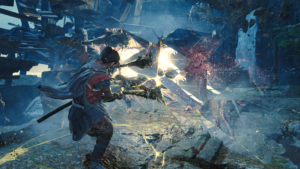
review – Onimusha: Way of the Sword
Draw your katana and adjust your Oni gauntlet. Twenty years after the last all-new installment on PS2, Capcom is reviving one of its most iconic franchises with *Onimusha: Way of the Sword*. Forget the “Resident Evil with swords” label and the static cameras of the 2000s: this soft reboot, powered by the RE Engine, reinvents the franchise as a pure, cinematic action game set in semi-open areas. After spending dozens of hours slashing away at Genma, here’s the full, no-holds-barred review!
Miyamoto Musashi: The Resurrection of Toshiro Mifune
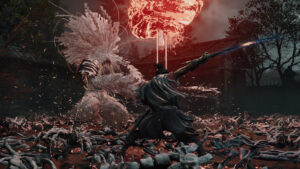
Gone are the Sengoku period settings of the first games: the action takes place during the Edo period, an era theoretically pacified by the Tokugawa shogunate. After winning a duel against his legendary rival Sasaki Ganryu, the wanderer Miyamoto Musashi and his opponent are ambushed and slaughtered by demons called Genma. Resurrected in hell by a strange old man, Musashi finds himself forced to wear an Oni gauntlet housing the soul of Shizuka.
To rid himself of this artifact—which he deeply loathes, for as a purist of the sword, he refuses to owe his strength to external magic—Musashi must purge the Malice corrupting Kyoto by devouring the souls of monsters. Meanwhile, Ganryu also receives a gauntlet, but chooses to slaughter innocent people to increase his power tenfold.
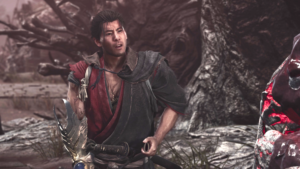
Musashi’s characterization is an absolute delight. Far from the valiant knight, he is an arrogant, grumbling vagabond who is clumsy outside of combat (the scene where he tries to use an oar without knowing what it is is hilarious), but deep down, he is profoundly human. Capcom carries on the saga’s tradition by drawing on the traits of a legendary, late actor: Toshiro Mifune (Akira Kurosawa’s favorite actor in the Samurai Trilogy). The recreation of Mifune’s mannerisms—right down to the way he scratches the back of his head or his gait—is strikingly respectful and natural.
The Japanese voice cast (Yoshimasa Hosoya as Musashi and Aya Endō as Shizuka) delivers a masterful performance. The dynamic between Musashi, Shizuka, the elderly gatekeeper of the Gates of Hell, Ono no Takamura, and the young Okuni (the historical founder of Kabuki) forms the emotional heart of the game.
The Edge of the Issen: A visceral dueling system
Don’t expect a simple, punishing Souls clone, nor a frantic beat ’em up in the style of Devil May Cry. Way of the Sword is built around an ultra-rhythmic fencing system where every strike must be deliberate:
-
No stamina gauge for attacking: Musashi can strike (light and heavy attacks) and sprint without stamina restrictions. Stamina management primarily concerns defense.
-
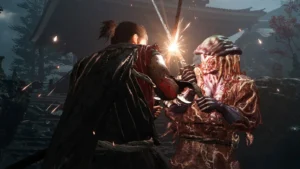
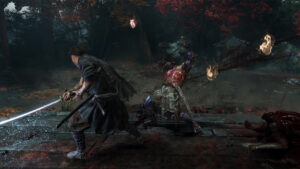
Parries, deflections, and reflexes: Blocking mindlessly drains your stamina and leaves you vulnerable to a fatal guard break. On the other hand, deflecting an attack with perfect timing sends sparks flying, charges the Blazing gauge to set your blade ablaze, and destabilizes your opponent. Reflex Dodges, meanwhile, allow you to follow up with swift counters.
-
The iconic “Issen” counter: The defensive Holy Grail. By pressing the attack button at the exact millisecond the enemy’s strike is launched, Musashi dodges with a lightning-fast sidestep and slices his opponent in two in a jubilant slow-motion sequence. You can even chain together multiple Chain Issens to wipe out an entire pack, or execute a Break Issen targeted at a boss’s weak points to choose between dealing massive damage or harvesting extra healing souls.
Interaction with the environment adds a unique flair: impaling a door on the ground to use it as a shield or deflecting an enemy arrow straight into a guard’s head during close-quarters combat with a sword strike never misses.

Memorable boss battles, but filler in town
The game shines in its major showdowns. The battles against Sasaki Ganryu, Benkei, and the Great Nue are orchestrated with a sense of spectacle and cinematic staging worthy of the best moments in *Metal Gear Rising* or *God of War*. The bosses have multiple health bars and distinct phases, and they, too, can absorb the souls scattered throughout the arena to mutate and unlock new devastating attacks.
The weak point of the Kyoto hub: While the story-driven quests (“Mysteries”) and the tales shared by the spirit of Lady Murasaki are fascinating and enrich the lore of Japanese folklore (saving the adorable lion-dogs grants access to genuine mythological tales), exploring Kyoto feels a bit like filler. Generic skirmish missions where you repeatedly rescue the same villagers from three identical demons quickly become tedious. Furthermore, several mini-bosses (such as the Byakue) are reused far too often.
A technical feat powered by the RE Engine (including on Switch 2)
Visually, Capcom’s in-house engine works wonders:
-
Atmosphere and Art Direction: The city of Kyoto transforms from a stifling, macabre gray landscape ravaged by Malice into shimmering, lush green vistas as purifications take place, reminiscent of the visual style of *Kunitsu-Gami*.
-
The technical marvel: The facial animations and the grotesque monster designs command respect. On Nintendo Switch 2, the game stands out as a true technical showcase: the level of detail in the environments and the exemplary frame rate stability put an end to the usual blurry compromises of mobile ports.
The game offers a playtime of about 20 hours on a straight run, which can climb to over 40 hours for completionists who want to unlock all the charms, max out the three soul gauges (yellow for healing, red for skills, blue for Oni weapons), and tackle the Carnage difficulty mode in New Game Plus.
The Demon Sword’s Return to Glory
Onimusha: Way of the Sword marks one of Capcom’s most spectacular comebacks. Driven by the magnetic presence of Musashi/Mifune, a dark atmosphere steeped in authentic Japanese mythology, and a katana combat system that’s exhilaratingly elegant, the game has already established itself as one of the pinnacles of action gaming in 2026. Despite side quests that are sometimes too repetitive, the surgical precision of its counters and the grandeur of its bosses make it well worth playing.